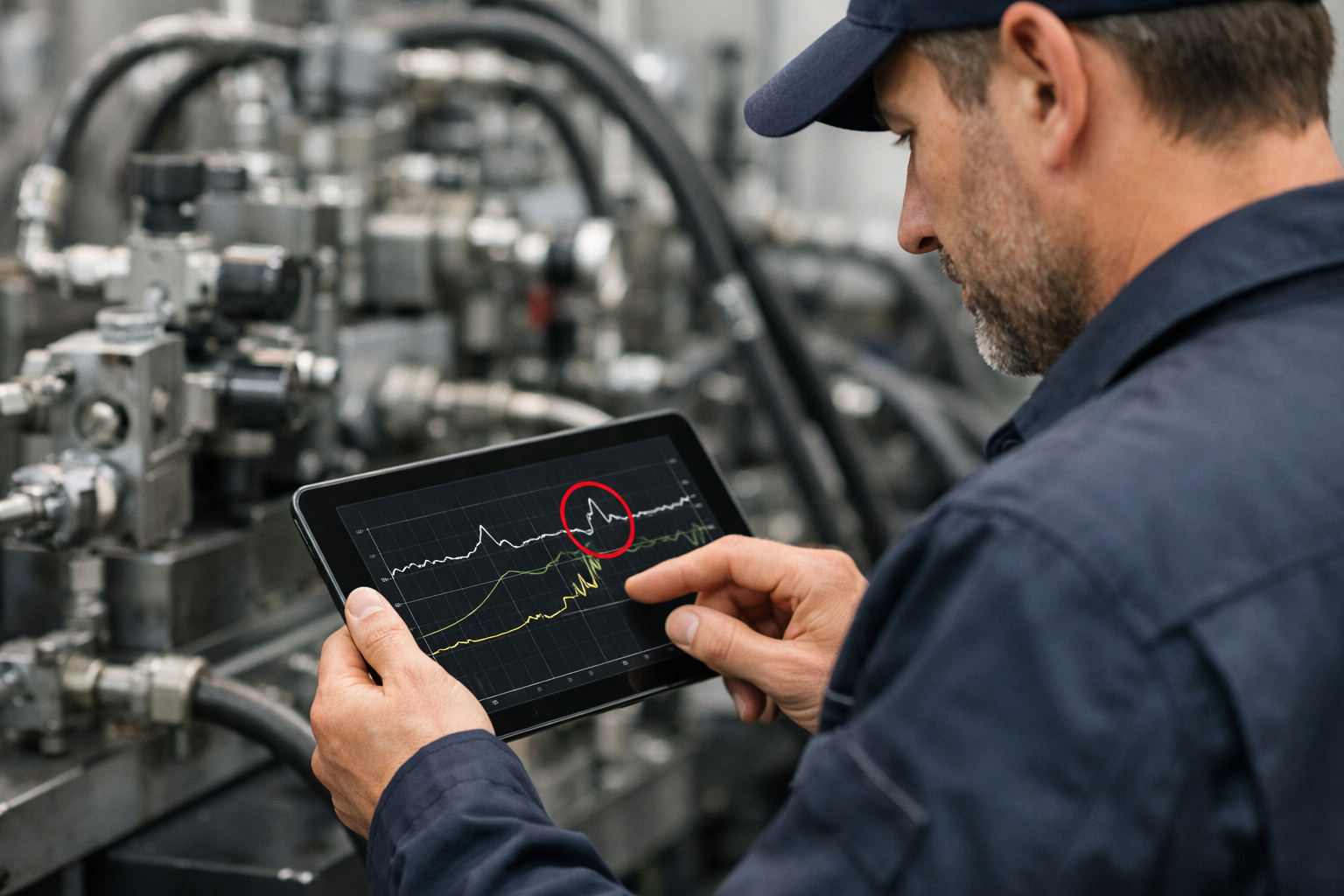
Downtime is rarely “bad luck”. There are usually warning signs beforehand.
In German SMEs, maintenance is often planned as follows: fixed intervals, fixed checklists, fixed spare parts. This seems orderly. However, it is often expensive. Because real problems do not follow the calendar. They follow stress, wear and tear, and process deviations.
The question is not: “Have we maintained?”
The question is: “Did we do the right thing at the right time?”
Bosch Rexroth: Condition-based maintenance in its own factory
In a case study from its Homburg plant, Bosch Rexroth describes how condition-based maintenance was used on hydraulic test benches. The aim was to reduce malfunctions caused by contamination, minimise unnecessary maintenance measures and achieve more consistent quality. In one specific case, a 5% increase in efficiency is cited.
This is not marketing “wishy-washy” talk, but precisely the leverage that SMEs feel:
-
fewer unplanned stops,
-
fewer “precautionary” part replacements,
-
greater process stability.
What constitutes “knowledge” – and why AI makes sense here
Condition-based maintenance only works if you detect deviations early on:
-
Pressure curves change,
-
Temperatures drift,
-
Vibrations increase,
-
Cycle times become “unstable”.
AI is good at filtering such patterns from data. It finds deviations faster than the eye. It recognises combinations that people overlook in everyday life. But: AI does not automatically tell you what to do. That remains a human decision.
The SME construction kit: Getting started can be this small
You don’t need a “major Industry 4.0 overhaul”. Start like this:
-
Choose a bottleneck system. The one that determines the line.
-
Measure 2–4 signals that you already have or can easily add.
-
Define 3 typical fault patterns (e.g. leakage, contamination, bearings).
-
Determine: “What does 1 hour of downtime really cost us?”
-
Decide after 8–12 weeks: scale up or stop.
This is precisely where “AI-supported, but human-led” comes in:
AI organises signals. Humans evaluate causes. Humans set priorities.
What SMEs can learn from this
-
Scheduled maintenance is often more expensive than necessary.
-
A small pilot project can be enough to prove the benefits.
-
AI helps with pattern recognition. People take the action.
-
The goal is not “more data”. The goal is less downtime.